Establishing a Foundry Business
By 1855, Albert Milsted had fully immersed himself in the world of engineering and iron founding. His name first appeared in connection with the trade in The London Gazette on 27 October 1855, marking the beginning of his partnership in Roberts & Co. The firm operated from the Barbican and Martin Street foundries in Plymouth, an industrial centre renowned for its shipbuilding and engineering enterprises.
The official notice read:
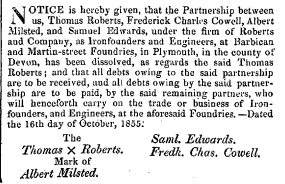
Though the partnership dissolved shortly after, this marked a significant step in Albert’s career—his first verifiable engagement as an engineer. His ability to transition from hat-making and public houses into a highly technical field suggests strong business acumen and adaptability.
Plymouth’s Industrial Boom
While specific details about Roberts & Co. are limited, the Barbican and Martin Street foundries in Plymouth, where the company operated, were integral to the city’s industrial landscape. These foundries produced essential cast iron and machinery components for shipbuilding, railways, and other industries. The demand for such products was high during the mid-19th century, offering significant growth potential for well-managed enterprises.
Who Were Albert’s Business Partners?
Albert’s partnership in Roberts & Co. was alongside three other men, each bringing different experience to the firm:
- Thomas Roberts (b. 1804) – An experienced iron foundry foreman, originally from Glamorgan, Wales, but settled in Plymouth by 1841. His extensive industry knowledge would have been invaluable.
- Frederick Charles Cowell (b. 1832) – The son of a Customs Officer, Cowell started his career as a solicitor’s clerk but transitioned into iron founding. In 1853, he married Margaret Roberts, Thomas Roberts’ daughter, strengthening family ties within the business.
- Samuel Edwards – Little is known about Edwards, but his inclusion suggests he had either financial investment or technical expertise relevant to the partnership.
Despite the promising nature of the venture, internal disagreements or financial difficulties led to Roberts & Co. dissolving within months of Albert joining.
Albert’s Early Role in the Company
Albert’s exact role in the business remains unclear. Given his lack of formal engineering training, it is likely that he contributed more on the commercial and administrative side rather than in technical design or production. His background in managing public houses may have equipped him with the necessary skills in finance, negotiations, and networking—essential for securing contracts and clients.
The rapid dissolution of the partnership raises intriguing questions. Was Albert struggling to establish himself as an engineer? Or did financial instability and mismanagement within Roberts & Co. force his exit?
The End of Roberts & Co. and New Beginnings
The frequent changes in partnerships within Roberts & Co. suggest challenges common in the volatile industrial economy of the time. Financial instability, fluctuating demand for iron goods, and increased competition from larger, more established foundries likely created difficulties in maintaining profitability. The mid-19th century also saw shifts in government contracts and supply chains, which could have impacted smaller firms like Roberts & Co. Additionally, disagreements between partners regarding business strategy or investment decisions may have contributed to the frequent restructuring.
Albert Milsted’s involvement in these partnerships, despite lacking formal engineering training, indicates his adaptability and determination to establish himself in the engineering sector.
By March 1856, the firm underwent another major change. A notice published in The London Gazette announced:
“NOTICE is hereby given, that the Partnership between Albert Milsted, Samuel Edwards, Frederick Charles Cowell, and John Anthony, as Iron Founders and Engineers, at Barbican and Martin-street Foundries, in Plymouth, has been dissolved, as regards the said Samuel Edwards and Frederick Charles Cowell…” (London Gazette, 25 March 1856)
Cowell and Edwards departed from the business, leaving Albert and a new partner, John Anthony, to continue operations. However, within a year, this partnership would also end.
Albert’s transition from hat-making and public house management to engineering reflects the broader societal shifts of Victorian Britain. The era was marked by social mobility, where individuals with ambition and acumen could redefine their careers. Albert’s story exemplifies this dynamic, showcasing how determination and strategic partnerships could lead to new opportunities in a rapidly industrializing society.
In the next blog, we will explore how Albert navigated these turbulent business changes and what the continuous shifts in partnerships reveal about his ambitions and struggles in the engineering world.
 Albert Milsted: A Man of Victorian Reinvention
Leave a comment