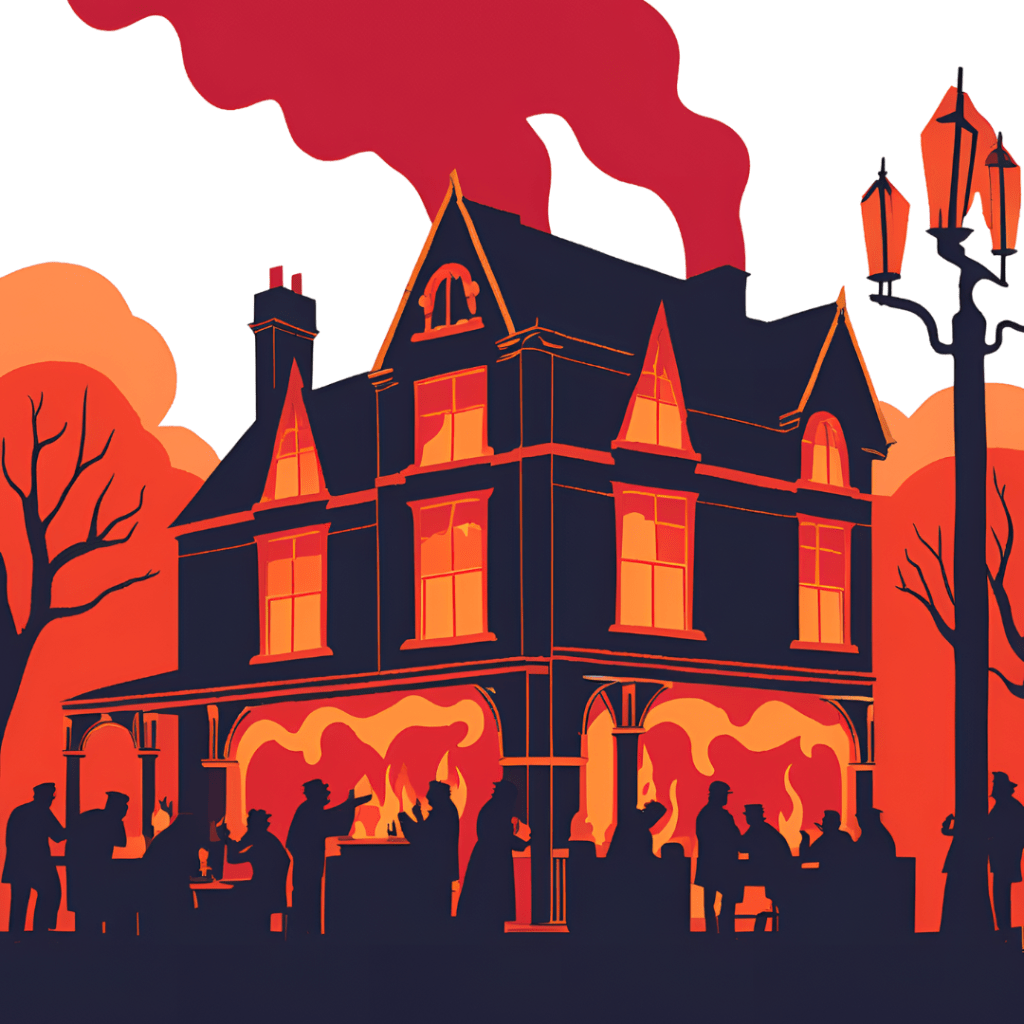
The night of 6 June 1843 was one that would be forever burned into the history of Bristol’s Castle Street. The Old Castle tavern, run by Thomas Worthington and his wife Mary Ann, became the scene of a horrifying tragedy when a devastating fire broke out, consuming the ancient wooden building in minutes.
The alarm was raised just before midnight. Fire engines from the public fire-offices arrived swiftly, but the inferno had already taken hold. Water was scarce at first, hampering the firefighters’ efforts, until private pumps were opened by local residents. But the flames, once ignited, proved unstoppable.
The worst was yet to come.
Inside the burning tavern, Thomas Worthington lay in bed, helpless. Stricken by a severe disease of the brain and nervous system, he had been completely bedridden for months. A young girl, Lydia Groves, niece of Mary Ann, had been caring for him, and she had been the first to notice the flames. Panicked, she attempted to extinguish the fire, but in doing so, she set herself ablaze. Her screams filled the air, alerting Mary Ann and the others downstairs.
What happened next remains a subject of controversy and sorrow. The Bristol Mirror reported:
“The most melancholy part of the affair remains to be told – the landlord, Mr. Thomas Worthington, fell a sacrifice to the devouring element, and, horrible to relate, was burnt to death in his bed.” (Bristol Mirror, 9 September 1843)
Mary Ann, upon realising the danger, rushed to save her husband. But, according to reports, several men at the scene physically prevented her from entering the burning room. Their reasoning? They feared that opening the door fully would cause the flames to spread more rapidly. Mary Ann was forcibly restrained and, in her desperation, shoved down the stairs.
The fire spread mercilessly. Despite the efforts of neighbours and firemen, the structure was beyond salvation. It was only after the blaze was quelled that the true horror was discovered. The remains of Thomas Worthington were found beneath the wreckage, his body blackened and unrecognisable. The newspaper report described the grim scene:
“The jury then proceeded to view the remains, which presented a horrifying spectacle. The features were distorted and blackened. The right arm, and the right leg from the hip, was gone, as was also the left leg above the knee-joint.” (Bristol Mirror, 9 September 1843)
The same newspaper article heavily criticised the inaction of the men present at the scene:
“Half a minute would have sufficed to have dragged the helpless sufferer from his bed, whose frame was so wasted by disease that a woman could have carried him with ease. In the name of humanity, we ask, why was he abandoned to his dreadful fate?” (Bristol Mirror, 9 September 1843)
Mary Ann, devastated and in shock, suffered violent fits in the days following the fire. She was in such distress that she was unable to give testimony during the initial inquest.
But the tragedy did not end with Thomas’s death. Little Lydia Groves, severely burned and traumatised, was taken to the infirmary. The newspapers reported on her condition, stating that she remained insensible for days. The Bristol Mercury later confirmed the worst:
“Since our last publication, the little girl, Lydia Groves, who is supposed to have occasioned the above melancholy event, has died, in the Infirmary, of the injuries she received in her endeavors to extinguish the bed-curtains.” (Bristol Mercury, 16 September 1843)
The coroner’s inquest, held at the Castle and Ball Tavern, concluded that both Thomas and Lydia had died as a result of an accident. The jury ruled that Thomas had been “accidentally burnt to death in his bed.” But lingering questions remained. Why had Mary Ann been held back? Could more have been done to save Thomas? And what had truly started the fire?
As the legal process unfolded, both Mary Ann’s son, Frederick, and the young Albert Milsted were called to appear in court. Their connection to the events of that night was scrutinised, though records suggest that neither was held responsible for the tragedy. The circumstances surrounding their involvement in running the tavern and their actions that evening only deepened the mystery surrounding the fire.
Albert Milsted, just 17 years old at the time, had been working at The Old Castle as an assistant to Mary Ann, helping with the day-to-day running of the business. His presence there may have been due to his growing relationship with the family, particularly with Mary Ann, though his exact role remains unclear. The two young men—Frederick and Albert—had left the tavern earlier in the evening to attend a musical performance at the Castle and Ball, another public house in the area, a decision that meant they were not present when the fire broke out. Their absence at such a crucial moment may have spared them from physical harm, but it also raised questions about what would have happened if they had remained at The Old Castle.
The only certainty was that Mary Ann had lost everything. Her husband was dead. The inn was gone. And her reputation would never fully recover.
Yet, from the ashes of tragedy, a new chapter was about to begin—one that would prove even more shocking. A year later, in 1844, Mary Ann married again. But this time, her husband was not a man of her own age or standing. Instead, she wed a 17-year-old assistant from The Old Castle tavern.
His name? Albert Milsted.
To be continued in Blog 3: A Marriage of Convenience? The Mysterious Disappearance of Albert.
 Albert Milsted: A Man of Victorian Reinvention
Leave a comment