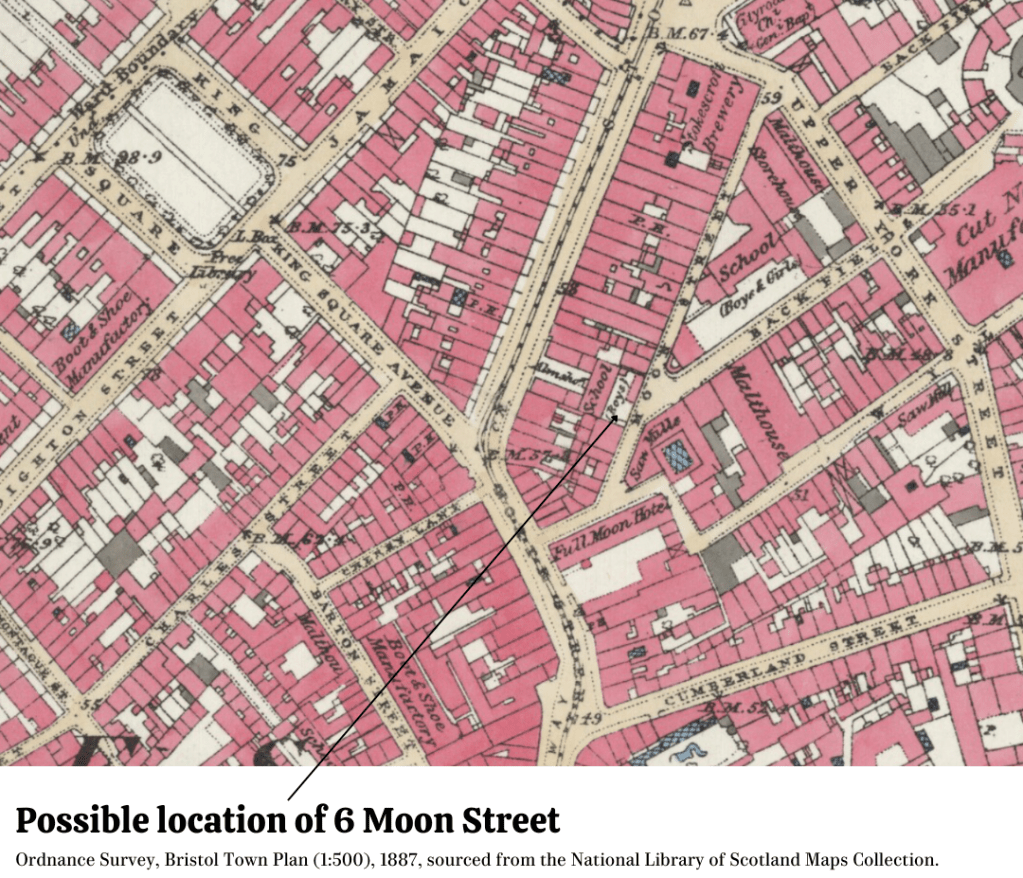
The 1841 Census records Robert and his family living in St James Churchyard, a bustling area of shops and houses surrounding the graveyard of St James Priory and the nearby Haymarket. More precisely, Pigot’s Directory of Gloucestershire (1842 and 1844) lists Robert’s business premises at 6 St James Parade.
The earliest map of this area, surveyed between 1882-1884, shows the layout of St James Churchyard, but major urban development in Bristol did not occur until after World War II.

Living Conditions in Victorian Bristol
It is highly likely that Robert’s home lacked running water. Instead, residents would have shared an outdoor water pump and communal outside toilets with their neighbours. Household rubbish was typically discarded into the streets, contributing to the unsanitary conditions of the time. Houses were crammed together, making air circulation poor and increasing the risk of disease.
Bristol was struck by three major cholera outbreaks during the 19th century:
- 1832
- 1848-1849
- 1868
The combination of overcrowding, poor sanitation, and lack of clean drinking water made these epidemics particularly devastating in urban areas like St James Churchyard.
Robert’s Hat-Making Business and Financial Struggles
Robert was listed in business directories regularly, suggesting his hat-making business was initially successful. However, in 1842, he appeared in court twice—in March and November—as an Insolvent Debtor. Reports of his financial difficulties were published in both local and national newspapers.
At both Bristol Guildhall court hearings, Robert was unopposed and “discharged forthwith.” Unfortunately, the records do not specify how much he owed or to whom.
By November 1842, newspaper reports indicate that Robert was lodging in Newfoundland Street, a short distance from St James Churchyard. More significantly, The London Gazette (1 July 1842 – 28 October 1842) states that Robert had been imprisoned in Bristol Gaol before his second court hearing.
Debt and Debtors’ Prisons in Victorian England
Debt was a widespread issue in Victorian Britain, largely driven by:
- A growing population
- High unemployment
- Low wages
- Heavy taxation
- The deflation of the pound
During the 18th and early 19th centuries, over half of all prisoners were incarcerated due to debt. The Insolvent Debtors (England) Act of 1813 allowed debtors to apply for release after 14 days in prison, provided their debts did not exceed £20.
Unlike convicted criminals, Insolvent Debtors were held in separate prison wings and were allowed more visitors. Their release depended on:
- Someone paying their debts
- Their ability to earn enough in prison to settle their obligations
Under the 1823 Prisons Act, debtors could not be forced into hard labour and were not required to work on the treadwheel unless they gave their consent.
 Albert Milsted: A Man of Victorian Reinvention
Leave a comment